
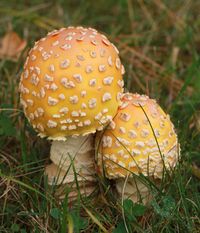
Royal fly agaric – Amanita regalis in the plant encyclopedia
The less common brown relative of red fly agaric: striking in appearance, intriguing in natural history and requiring particular caution.
Royal fly agaric, botanically Amanita regalis, is a striking mushroom in the Amanita family. Also called brown fly agaric, it is a close relative of the familiar red fly agaric, Amanita muscaria. While the classic fly agaric is known for its bright red cap and white spots, royal fly agaric usually has a brown to yellow-brown cap with pale, flaky veil remnants. This makes it look less like a fairy-tale mushroom, but often more robust and primeval.
In the wild, Amanita regalis occurs mainly in cooler European woodlands. It forms mycorrhiza, a symbiotic association with trees, particularly spruce. The German Mycological Society chose royal fly agaric as its Mushroom of the Year 2000 and notes that, unlike red-capped fly agaric, it has a brown cap.
Like red fly agaric, royal fly agaric is not an edible mushroom. It is described as a poisonous species and must not be confused with edible woodland mushrooms. Mushroom descriptions explicitly identify Amanita regalis as royal or brown fly agaric and place it in the Amanita family.
Amanita regalis is particularly interesting because of its close relationship to red fly agaric. Both mushrooms are associated with similar constituents, particularly ibotenic acid and muscimol. These substances are responsible for the distinctive effects of various fly agaric species. Drying and heat can partly convert ibotenic acid into muscimol.
Note: Our shop offers selected royal fly agaric products with clearly stated origins and careful processing.
Royal fly agaric – product details
Muscimol acts on the central nervous system and is associated in specialist literature with GABA receptors. The German Federal Institute for Risk Assessment describes the toxic effects of fly agarics mainly in connection with ibotenic acid and muscimol.
Personal accounts and ethnobotanical discussions sometimes consider royal fly agaric in a similar way to Amanita muscaria. People are mainly interested in its possible consciousness-altering properties and subjectively reported effects on relaxation, sleep, dream perception, inner calm and mood. These reports come mainly from personal experiences, forums, ethnobotanical texts and modern internet culture. They must not be understood as established effects and certainly not as recommendations for use.
Royal fly agaric is less familiar and less frequently described than red fly agaric. This makes particular caution important. Considerably less generally accessible information is available about the precise potency, composition and tolerability of Amanita regalis than of Amanita muscaria. As with many wild mushrooms, active-constituent levels can vary greatly. Location, tree species, soil, climate, season, fruiting-body age, drying and storage may all play a role.
Some online sources portray royal fly agaric as a particularly potent or “stronger” member of the fly agaric group. Such statements should be considered cautiously, because the actual composition of wild mushrooms may vary greatly. What one personal account describes as mild, clear or relaxing may be unpleasant, confusing or distressing in another case.
Depending on amount, processing and individual sensitivity, effects described in connection with fly agaric species include tiredness, relaxation, altered perception, vivid dreams, inner distance, a feeling of heaviness, intoxication and light-headedness. Unwanted reactions may also include nausea, vomiting, dizziness, confusion, impaired coordination, trembling and severe tiredness. Royal fly agaric should therefore not be treated casually.
It is also important to distinguish it clearly from psilocybin-containing mushrooms. Like red fly agaric, royal fly agaric contains no psilocybin. Its distinctive properties are associated mainly with ibotenic acid and muscimol, rather than psilocybin or psilocin. It therefore differs from so-called “magic mushrooms” both chemically and in its effects.
A cautious assessment is necessary from legal and health perspectives. In many European countries, fly agaric species such as Amanita muscaria and Amanita regalis are not authorised as foods or food supplements. The information provided here is intended solely for general education, natural history and ethnobotanical context. It is not a recommendation for ingestion, dosage or use.
Royal fly agaric is a particularly fascinating member of the fly agaric relatives: rarer, darker and less well known than red fly agaric, but equally intriguing from a natural-history perspective. Its close relationship to Amanita muscaria makes it interesting, while also making it a mushroom that should be approached with respect, caution and factual information.
If you would like to learn more or view available products, you can find our current selection here: