
Fly agaric – Amanita muscaria in the plant encyclopedia
The red fly agaric is one of the world’s best-known mushrooms, fascinating for its appearance, cultural history and distinctive constituents.
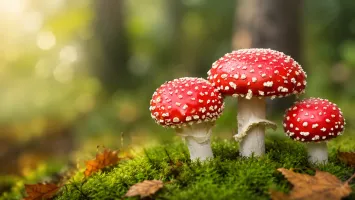
Fly agaric, botanically Amanita muscaria, is one of Europe’s most striking and symbolic mushrooms. Its bright red cap and white spots are deeply embedded in fairy tales, folk beliefs, natural history and modern mushroom culture. Although often depicted as a symbol of good luck, it is also a mushroom that must be approached with particular caution.
In the wild, Amanita muscaria grows mainly in forests of the Northern Hemisphere. It lives in symbiosis with trees such as birch, spruce, pine and fir and is especially widespread in boreal and temperate woodlands. Its striking appearance makes it recognisable, but it should not be mistaken for an ordinary edible mushroom.
The principal known constituents of fly agaric are ibotenic acid and muscimol. Drying and heat can partly convert ibotenic acid into muscimol. These substances act on the central nervous system and are associated in specialist literature with the mushroom’s distinctive psychoactive properties. Inappropriate use can also cause unwanted and sometimes dangerous effects. The German Federal Institute for Risk Assessment notes that fly agaric’s toxic effects are mainly attributed to ibotenic acid and muscimol.
Historically, fly agaric has appeared in various cultures, particularly in connection with Northern Eurasian and Siberian traditions. There, Amanita muscaria was sometimes used in ritual, folk or consciousness-altering contexts. In Europe, too, the mushroom has featured in stories, symbolism and nature myths for centuries. Many modern accounts of fly agaric therefore sit between natural history, ethnobotany, folk belief and contemporary personal reports.
Interest in fly agaric has grown considerably in recent years. Numerous personal accounts online describe so-called fly agaric microdosing practices. People report using very small amounts of dried fly agaric powder and subjectively describe greater inner calm, better sleep, a more relaxed mood, increased resilience, more focus or a more balanced experience of everyday life. These are personal experiences and do not replace scientific assessment. The European Food Safety Authority has described increasing consumption of Amanita muscaria as an emerging risk, particularly as it is increasingly marketed for relaxation, sleep support or mental balance.
Amanita muscaria is also increasingly discussed in scientific publications. These focus particularly on muscimol and ibotenic acid, their pharmacological properties and possible risks from consumption or overdose. Case-report literature also discusses its increasing availability and intentional consumption.
Importantly, the effects of fly agaric can vary greatly. Active-constituent levels depend on location, season, the mushroom’s age, drying, storage and processing.
Origin, drying and storage are particularly important for fly agaric products. Our fly agarics are carefully dried and stored for a sufficient period before sale.
Personal accounts therefore cannot simply be transferred to other products or people. What one person describes as pleasant or subtle may be unpleasant, confusing or distressing for another.
Depending on amount, processing and individual sensitivity, reported effects associated with Amanita muscaria include relaxation, drowsiness, altered perception, vivid dreams, a sense of inner distance, light-headedness or intoxication. Unwanted reactions may also include nausea, vomiting, confusion, impaired coordination, trembling, severe tiredness and other symptoms of poisoning. This illustrates why the mushroom requires a particularly responsible approach.
Fly agaric contains no psilocybin and differs clearly from so-called “magic mushrooms”. Its effects are associated mainly with muscimol and ibotenic acid, rather than psilocybin or psilocin. Amanita muscaria therefore differs from psilocybin-containing mushrooms both chemically and in its effects.
Particular caution is appropriate from legal and health perspectives. In many European countries, fly agaric is not authorised as a food or food supplement. The information provided here is intended solely for general education, natural history and ethnobotanical context. It is not a recommendation for ingestion, dosage or use. Anyone exploring Amanita muscaria should always consult the applicable legal situation, possible risks and expert information.
Fly agaric remains an unusual natural substance: visually distinctive, culturally deeply rooted and scientifically interesting, while also requiring respect, caution and a clear distinction between information and use.
If you would like to learn more or view available fly agaric products, you can find our current selection here: