
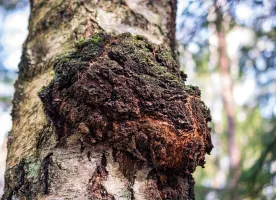
Chaga mushroom (Inonotus obliquus)
Chaga is one of the best-known functional mushrooms of northern forests. Various cultures have valued it as a distinctive natural substance for centuries, traditionally using it in teas and extracts.
Chaga, scientifically named Inonotus obliquus, is an unusual tree fungus found mainly in cold regions of the Northern Hemisphere. It grows particularly often on birches in the boreal forests of Russia, Scandinavia, Canada and parts of Eastern Europe. Its dark, cracked exterior initially resembles charred wood more than a typical mushroom. Inside, however, it has warm orange-brown tissue that has long attracted attention in traditional natural history and ethnobotanical uses.
Chaga holds a special place in a mushroom encyclopedia because of its close cultural and natural-history connection with the harsh woodlands of the north. In many parts of Siberia, chaga was traditionally used as an infusion. Historical accounts from parts of Finland, Poland and the Baltic region also describe its use in teas or decoctions. Folklore often regarded chaga as a valuable woodland natural substance associated with vitality, resilience and general well-being.
The name “chaga” probably comes from Russian and was adopted internationally. The scientific name Inonotus obliquus identifies it within the family Hymenochaetaceae. It grows mainly on living birches, developing its characteristic structure over many years. Harvesting is usually done by hand from wild sources, making origin and sustainable gathering important for high-quality products.
Chaga has a striking appearance. Its exterior has a deep-black, cracked surface caused by deposited melanin. This hard outer layer protects the much lighter inner tissue. Chaga grows slowly and may remain on a tree for many years. It is therefore regarded as a particularly dense, concentrated natural substance.
Chaga’s constituents have attracted scientific attention for some time. Natural antioxidants, polyphenols, beta-glucans and various secondary plant and fungal compounds are frequently discussed. Chaga also contains natural compounds such as triterpenes and melanin, the latter associated with its dark colour. Scientific investigations explore which constituents might be relevant to particular traditional uses. In many areas, however, the evidence remains inconclusive.
Traditionally, chaga was often used as a hot infusion or mushroom tea. Some cultures included it in general well-being and fasting traditions. Personal accounts describe an earthy, mild flavour and particular appreciation of this woodland fungus’s natural character. People interested in functional mushrooms, natural substances and traditional plant encyclopedias are also increasingly exploring chaga and its historical significance.
Origin, processing and quality are particularly important for chaga products. High-quality chaga often comes from cold woodlands and is gently dried to preserve its natural characteristics as well as possible. Many users particularly value wild collections from northern birch forests. Our shop offers carefully selected chaga products with transparent origins and gentle processing.
View premium wild-collected chaga in the shop:
https://fliegenpilz-kaufen.de/en/products/premium-chaga-pilz-aus-wildsammlung
Processing may vary greatly by product. Some chaga products contain coarsely cut pieces, others fine powder or concentrated extracts. Many manufacturers aim for low processing temperatures to protect sensitive constituents. Storage and purity are also important. High-quality chaga should be stored dry, away from light and without unnecessary additives.
Modern discussions of natural substances often mention chaga alongside adaptogens, functional mushrooms and traditional woodland products. Interest in unprocessed, wild-collected raw materials is growing particularly in natural-history circles. At the same time, it is increasingly emphasised that traditional personal accounts should not be equated with medical statements. Many described effects are based on cultural traditions, personal experiences or early scientific investigations.
As with many natural substances, chaga has possible limitations and cautionary considerations. Personal accounts and specialist texts occasionally note that certain constituents, including oxalates, should be considered for sensitive individuals. People with existing conditions, taking medication or feeling uncertain should seek expert information before exploring particular natural substances in greater depth. Legal classifications may also differ by country.
Chaga nevertheless remains one of the most fascinating traditional woodland fungi and natural substances. Its long history, distinctive appearance and connection with northern birch forests make it a familiar part of modern mushroom encyclopedias and ethnobotanical collections. Many people today are interested both in its constituents and traditional uses and in the cultural history and natural-history background of this unusual fungus.
If you would like to learn more or view available products, you can find our current selection here:
https://fliegenpilz-kaufen.de/en/products/premium-chaga-pilz-aus-wildsammlung
The information provided here is intended solely for general education, natural history and ethnobotanical context. It is not a recommendation for ingestion, dosage or use. Legal requirements may differ by country. Anyone exploring this natural substance should learn about the applicable legal situation and possible risks.